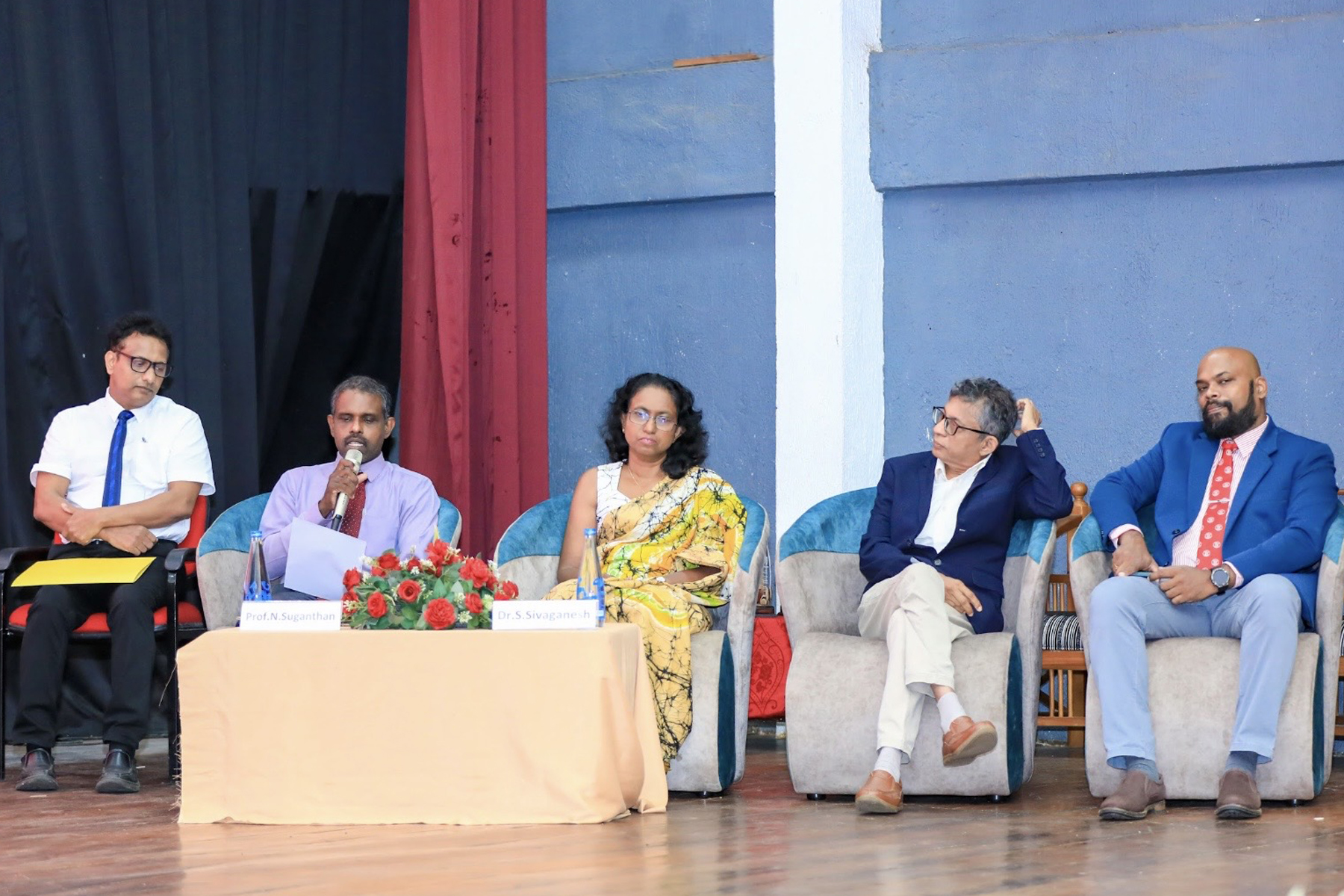
Two academics from the Faculty of Medicine and Allied Sciences (FMAS), Rajarata University of Sri Lanka, took part as speakers at the Research Conference of the Faculty of Medicine, University of Jaffna (RCFMJ 2026). The conference was held on 22 October 2026 at the Hoover Auditorium, Faculty of Medicine, University of Jaffna, under the theme “Transforming Evidence into Practice.”
Prof. Anjana Silva, Professor of Medical Parasitology, Department of Parasitology, FMAS, spoke in the symposium on Neglected Tropical Diseases. His presentation, “Why Local Evidence Matters: Lessons from Anuradhapura Snakebite Cohort,” drew on locally generated research to show why context-specific evidence is essential for effective clinical care and health policy.
Prof. Kumara Dissanayake, Professor in Gynaecological Endoscopy, Department of Gynaecology & Obstetrics, FMAS, presented in the symposium First Do No Harm. His talk, “The Right Evidence for the Right Clinical Question: Lessons from Gynaecological Laparoscopy,” addressed how clinicians can choose and apply appropriate evidence in minimally invasive gynaecological practice, with patient safety as the guiding principle.
Their participation reflects FMAS’s commitment to research-informed practice and to collaboration with other medical faculties in the country.
It also gave the Faculty a platform to share locally generated evidence from the region with a national audience.
Faculty of Medicine and Allied Sciences Academics Participate in RCFMJ 2026 at the University of Jaffna
Two academics from the Faculty of Medicine and Allied Sciences (FMAS), Rajarata University of Sri Lanka, took part as speakers at the Research Conference of the Faculty of Medicine, University of Jaffna (RCFMJ 2026). The conference was held on 22 October 2026 at the Hoover Auditorium, Faculty of Medicine, University of Jaffna, under the theme “Transforming Evidence into Practice.”
Prof. Anjana Silva, Professor of Medical Parasitology, Department of Parasitology, FMAS, spoke in the symposium on Neglected Tropical Diseases. His presentation, “Why Local Evidence Matters: Lessons from Anuradhapura Snakebite Cohort,” drew on locally generated research to show why context-specific evidence is essential for effective clinical care and health policy.
Prof. Kumara Dissanayake, Professor in Gynaecological Endoscopy, Department of Gynaecology & Obstetrics, FMAS, presented in the symposium First Do No Harm. His talk, “The Right Evidence for the Right Clinical Question: Lessons from Gynaecological Laparoscopy,” addressed how clinicians can choose and apply appropriate evidence in minimally invasive gynaecological practice, with patient safety as the guiding principle.
Their participation reflects FMAS’s commitment to research-informed practice and to collaboration with other medical faculties in the country.
It also gave the Faculty a platform to share locally generated evidence from the region with a national audience.